Running a business in Canada comes with many responsibilities, and managing your finances is one of the most important. While most business owners remember to claim obvious expenses like rent and inventory, many overlook smaller deductions that can significantly reduce their taxable income.
Missing eligible business expenses means paying more tax than necessary. By understanding which expenses qualify as tax deductions under the Canada Revenue Agency (CRA) guidelines, entrepreneurs can maximize their savings while staying compliant.
In this guide, we’ll cover five commonly overlooked business expenses every Canadian entrepreneur should claim and explain how proper bookkeeping can help ensure you never miss a deduction.
Why Claiming Business Expenses Matters
Every eligible business expense reduces your taxable business income. Lower taxable income means:
- Lower income tax payable
- Improved business cash flow
- Better financial planning
- Accurate bookkeeping records
- Reduced risk during CRA reviews
The key is keeping proper documentation and ensuring every deduction is supported with receipts and business records.
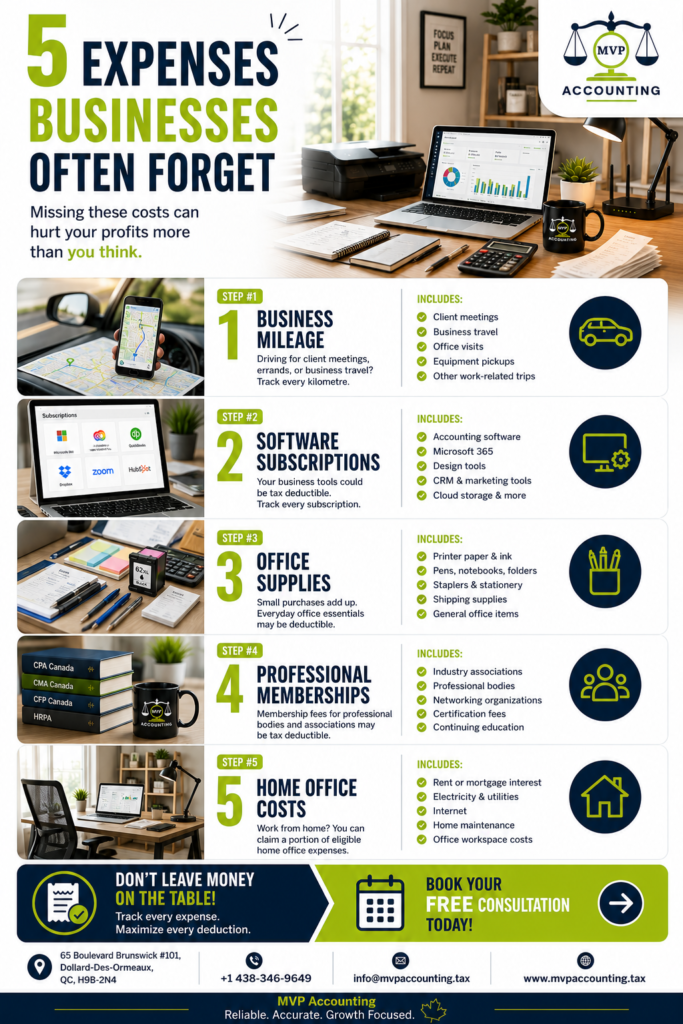
1. Home Office Expenses
Many entrepreneurs operate from home, especially freelancers, consultants, online businesses, and startups. If you use part of your home exclusively or primarily for business purposes, you may be eligible to claim a portion of your household expenses.
Eligible Home Office Expenses
- Rent
- Mortgage interest (where applicable)
- Property taxes (in certain situations)
- Electricity
- Heating
- Water
- Home insurance
- Internet services
- Maintenance and repairs related to the workspace
Typically, only the business-use portion of these expenses is deductible. The calculation is generally based on the percentage of your home’s floor space used for business and the amount of time it is used.
Example
If your home office occupies 15% of your home’s total area, you may be able to claim approximately 15% of eligible household expenses, provided the space meets CRA requirements.
2. Vehicle Expenses and Business Mileage
Many business owners use their personal vehicles for client meetings, supplier visits, deliveries, or business travel. These costs can become substantial over the course of a year.
Deductible Vehicle Expenses
- Fuel
- Insurance
- Repairs and maintenance
- Oil changes
- Tire replacement
- Registration fees
- Parking fees
- Business-related tolls
- Vehicle lease payments (subject to CRA limits)
- Capital Cost Allowance (for owned vehicles)
Don’t Forget Your Mileage Log
The CRA requires businesses to maintain accurate mileage records showing:
- Date
- Destination
- Purpose of the trip
- Kilometres driven
Without a proper mileage log, legitimate deductions may be denied.
3. Office Supplies
Office supplies are among the easiest expenses to overlook because they are often purchased throughout the year in small amounts.
Although individual purchases may seem minor, together they can represent hundreds or even thousands of dollars annually.
Common Deductible Office Supplies
- Pens and pencils
- Paper
- Notebooks
- Printer paper
- Printer ink and toner
- Shipping supplies
- Filing materials
- Desk organizers
- Postage
- Mailing envelopes
Business Software Subscriptions
Many software subscriptions used for business operations are also deductible, including:
- Accounting software
- Cloud storage
- Microsoft 365
- Google Workspace
- Project management software
- Customer relationship management (CRM) software
- Video conferencing platforms
- Design software
Keeping digital receipts makes these expenses much easier to track during tax season.
4. Professional Memberships and Association Fees
Professional memberships often provide networking opportunities, continuing education, certifications, and industry resources.
Many of these fees are deductible when they relate directly to your business.
Examples Include
- Industry association memberships
- Professional licensing fees
- Chamber of Commerce memberships
- Trade association dues
- Regulatory body fees
- Professional certifications
However, not every membership qualifies, so it’s important to verify eligibility according to CRA guidelines.
5. Staff Training and Professional Development
Investing in employee development benefits both your business and your team.
Training expenses that improve business-related skills are generally deductible.
Eligible Training Expenses
- Workshops
- Business seminars
- Professional conferences
- Industry certifications
- Online business courses
- Employee training programs
- Safety certifications
- Skill development courses
These investments can improve productivity while also reducing taxable income.
Tips to Ensure You Never Miss a Business Expense
Claiming deductions is much easier when your financial records are organized throughout the year.
Here are a few best practices:
- Keep every receipt (digital or paper).
- Separate business and personal expenses.
- Use dedicated business bank accounts and credit cards.
- Track mileage regularly instead of estimating later.
- Record expenses monthly instead of waiting until tax season.
- Review your bookkeeping frequently to identify missed deductions.
- Work with a professional accountant familiar with Canadian tax regulations.
Common Mistakes Business Owners Make
Many entrepreneurs unintentionally lose valuable deductions by making avoidable mistakes, such as:
- Throwing away receipts
- Mixing personal and business purchases
- Forgetting recurring software subscriptions
- Not tracking vehicle mileage
- Missing home office calculations
- Claiming expenses without proper documentation
- Waiting until year-end to organize finances
Good bookkeeping habits help eliminate these issues.
How Professional Bookkeeping Can Save You Money
Professional bookkeeping is about more than recording transactions. It helps identify deductible expenses, maintain organized financial records, and prepare accurate reports for tax filing.
A qualified bookkeeping team can help you:
- Identify overlooked deductions
- Maintain CRA-compliant records
- Track expenses throughout the year
- Prepare financial statements
- Reduce bookkeeping errors
- Save time and reduce stress during tax season
Instead of scrambling at year-end, you’ll have confidence that your records are complete and your deductions are fully documented.
Final Thoughts
Every dollar you fail to claim is money left on the table. By understanding these five commonly overlooked business expenses—Home Office Costs, Vehicle Expenses, Office Supplies, Professional Memberships, and Staff Training & Development—Canadian entrepreneurs can reduce taxable income, improve cash flow, and strengthen their business finances.
The key is maintaining accurate records, keeping proper documentation, and reviewing your expenses regularly. With professional bookkeeping support, you can ensure you’re claiming every eligible deduction while remaining compliant with CRA requirements.
If you’re unsure whether you’re maximizing your business deductions, consulting an experienced accounting professional can help you identify opportunities to save and keep your business financially healthy.
Why Choose MVP Accounting?
At MVP Accounting, we help Canadian entrepreneurs stay organized, maximize eligible tax deductions, and maintain accurate financial records year-round. From bookkeeping and payroll to tax planning and business advisory services, our team is committed to helping your business grow with confidence.
Contact Us Today
MVP Accounting
📍 65 Boulevard Brunswick #101, Dollard-Des-Ormeaux, QC, H9B-2N4
📞 +1 438-346-9649
🌐 www.mvpaccounting.tax
Frequently Asked Questions About Bookkeeping
How much should you pay someone to do your bookkeeping?
Bookkeeping costs depend on transaction volume, business complexity, software, payroll requirements and reporting needs. In Canada, a freelance bookkeeper may charge approximately CAD $30–$90 per hour, while outsourced monthly bookkeeping may cost around CAD $300–$2,000 or more. Request a quote based on your actual records and required services.
What is a bookkeeper not allowed to do?
A bookkeeper should work within their training, professional qualifications, engagement agreement and applicable laws. Bookkeepers generally maintain financial records, reconcile accounts and prepare reports, but should not claim credentials they do not hold, provide regulated professional services without authorization, or make unauthorized financial decisions for clients. Tax representation, assurance engagements and other regulated work may require specific qualifications or authorization.
Is it worth it to hire a bookkeeper?
Hiring a bookkeeper can be worthwhile if it saves business owners time, improves financial record accuracy, supports cash flow management and helps keep accounts organized for tax filing. It can be particularly valuable for businesses with regular transactions, employees, sales tax obligations or multiple bank accounts. Compare the service fee with the time and administrative effort you would otherwise spend.
How much do self-employed bookkeepers charge?
Self-employed bookkeepers in Canada may charge approximately CAD $30–$90 per hour, depending on experience, location, software knowledge and the complexity of the work. Some offer fixed monthly packages or project-based pricing for catch-up bookkeeping, reconciliations and financial reporting. These are indicative service-price ranges, not official regulated rates.
Is AI replacing bookkeepers?
AI is automating parts of bookkeeping, including transaction categorization, receipt extraction, bank-feed processing and anomaly detection. However, businesses still need human judgment for reconciliations, unusual transactions, accounting adjustments, compliance considerations and financial review. Bookkeepers who combine accounting knowledge with automation and cloud accounting software can use AI to improve efficiency rather than relying on manual data entry alone.
How much do QuickBooks bookkeepers charge?
QuickBooks bookkeeping fees depend on the bookkeeper’s experience, transaction volume, number of accounts, payroll, sales tax requirements and reporting scope. In Canada, an independent QuickBooks bookkeeper may charge approximately CAD $30–$90 per hour, or offer a monthly package. Confirm whether the QuickBooks Online subscription, payroll processing, tax filings and cleanup work are included in the quoted price.
Can I do bookkeeping without a CPA?
In Canada, you can generally perform routine bookkeeping without being a CPA. Maintaining records, categorizing transactions, reconciling accounts and preparing internal financial reports do not ordinarily require a CPA designation. However, certain assurance engagements, regulated services and specific tax or professional representations may have additional requirements. Check the rules applicable to your province and the exact services you intend to provide.
What does a bookkeeping service do?
A bookkeeping service records and organizes a business’s financial transactions. Typical services include categorizing income and expenses, reconciling bank and credit card accounts, recording accounts payable and receivable, tracking payroll transactions, maintaining sales tax records and preparing monthly financial reports. The exact scope depends on the service agreement and may include QuickBooks Online or other accounting software.
How much do bookkeepers cost per hour?
Freelance bookkeeping services in Canada may cost approximately CAD $30–$90 per hour, while established firms may charge more depending on the expertise and services provided. Hourly fees vary with transaction complexity, location, experience, cleanup requirements and reporting deadlines. Ask whether the quote includes software, payroll, sales tax preparation and year-end support.
Can I do my bookkeeping myself?
Yes. Many sole proprietors and small businesses can manage basic bookkeeping using accounting software, organized receipts, bank feeds and regular reconciliations. You should consistently record income and expenses, retain supporting documents and monitor applicable tax deadlines. Professional assistance may be useful when transactions become more complex, records fall behind or payroll and sales tax obligations increase.
What are the three types of bookkeeping?
Bookkeeping is commonly discussed in terms of single-entry bookkeeping, double-entry bookkeeping and computerized bookkeeping. Single-entry systems record transactions in a simpler format, double-entry systems record corresponding debits and credits, and computerized bookkeeping uses software to maintain and process accounting records. These are common ways to describe bookkeeping systems, rather than a universal official classification.
Is a bookkeeper cheaper than an accountant?
A bookkeeper is generally less expensive for routine transaction recording, account reconciliations and day-to-day financial record maintenance. An accountant may charge more for complex financial analysis, year-end adjustments, tax planning and other specialized work. The best choice depends on your needs: many small businesses use a bookkeeper for ongoing records and an accountant or CPA for year-end and specialized services.
What are the three golden rules of bookkeeping?
The traditional three golden rules of accounting are: debit the receiver and credit the giver for personal accounts; debit what comes in and credit what goes out for real accounts; and debit expenses and losses and credit incomes and gains for nominal accounts. These traditional rules are commonly taught in introductory accounting, although modern bookkeeping software applies the underlying double-entry principles through account types and accounting entries.
What is the current rate for a bookkeeper in Canada?
There is no single national rate for bookkeeping services. Freelance service fees may range from approximately CAD $30–$90 per hour, depending on experience, location and scope. As a separate benchmark, the Government of Canada’s Job Bank reported a median employee wage of CAD $28.02 per hour nationally and CAD $28.50 per hour in Ontario in data updated in November 2025. Employee wages and the fees charged by an independent business are different measures.
Do I need a CPA to be a bookkeeper?
No. Routine bookkeeping generally does not require a CPA designation in Canada. Relevant training, practical accounting experience, accuracy, confidentiality and knowledge of accounting software are important. A CPA or other appropriately qualified professional may be needed for specific regulated engagements or specialized tax and assurance services, depending on the applicable rules.
How should I price my bookkeeping services?
To price bookkeeping services, estimate the time required, transaction volume, number of accounts, payroll workload, sales tax complexity, software costs, overhead and desired profit. You can charge hourly for variable or one-time projects, offer fixed monthly packages for recurring work, or quote separately for catch-up bookkeeping and year-end preparation. Clearly document what is included, what costs extra and how additional work will be billed.
How much should I charge for bookkeeping services in Canada?
Independent bookkeepers in Canada may use an indicative hourly range of CAD $30–$90, while monthly bookkeeping packages may start at a few hundred dollars and increase with transaction volume, payroll and reporting complexity. These are broad market estimates rather than official rates. Research local competitors, calculate your costs and set prices that reflect your experience, service scope and business overhead.
What is a good hourly rate for a bookkeeper?
A good hourly rate balances the bookkeeper’s experience, local market, operating costs and the value of the service. In Canada, an independent bookkeeper might use CAD $30–$90 per hour as an initial pricing reference, adjusting for specialized software knowledge, complex reconciliations, payroll and sales tax requirements. More experienced professionals and accounting firms may charge higher rates.
What is the average hourly rate for a bookkeeper in Canada?
The answer depends on whether you mean an employee’s wage or the price a client pays for bookkeeping services. The Government of Canada’s Job Bank reported a median employee wage of CAD $28.02 per hour nationally, based on its published wage data updated in November 2025. Independent bookkeeping service fees are typically higher because they also cover business overhead, software, administration and profit.
What is the average hourly wage for a bookkeeper in Ontario?
The Government of Canada’s Job Bank reported a median bookkeeper wage of CAD $28.50 per hour in Ontario, with a published low of $19.23 and high of $46.15 per hour. The wage data was updated on November 19, 2025, and primarily reflects the 2023–2024 reference period. These figures represent employee wages, not the hourly fees charged by bookkeeping firms.
How can a Canadian small business choose a bookkeeping service?
Choose a bookkeeping service by reviewing its relevant industry experience, accounting software expertise, reconciliation process, reporting schedule, confidentiality practices, pricing and service scope. Canadian businesses should also confirm that the provider understands their applicable GST/HST or other sales tax obligations, payroll records and year-end requirements. Request a clear engagement agreement before sharing financial records.